DHW Director Dave Jeppesen: Please honor dads and granddads safely this weekend

The pandemic is not over. As states began to reopen, we are seeing increasing activity in Utah and Oregon, and in Idaho, we have seen the number of cases in our state increase over the past few days.

Because there is no vaccine or proven therapeutic interventions at this time, we have to take other precautions to slow the spread of COVID-19 in our state. It is up to each of us to protect our friends, families, neighbors, and community. You have heard these recommendations before, but they are worth repeating because they are more important than ever:
  • Keep at least six feet between you and others in public
  • Wear face coverings in public places (the Centers for Disease Control and Prevention advises the use of simple cloth face coverings to slow the spread of the virus and help people who may have the virus, and do not know it, from transmitting it to others)
  • Stay home if you are sick
  • Wash your hands often
  • Cover coughs and sneezes
  • Disinfect surfaces and objects regularly

Nationally, approximately 41 percent of cases are found in adults between the ages of 18 and 44. Several states are seeing a concerning recent trend with increasing cases among those under 40.

 In our own state, 49 percent of known cases are in Idahoans under the age of 40. Younger adults often feel invincible or have heard that having COVID-19 may not be a serious condition for them. It’s true that approximately 80 percent of cases are mild, but there are severe cases in all age ranges.

Continue reading “DHW Director Dave Jeppesen: Please honor dads and granddads safely this weekend”
Idaho needs your help: Even though we have entered Stage 4, the pandemic isn’t over

Idaho entered the fourth stage of its plan to reopen on Saturday. All Idaho businesses can open their doors and resume serving their customers, with recommended precautions in place. However, we are not out of the woods yet.

It is tempting to act as if life is back to normal, back to before COVID-19 was spreading in Idaho’s communities. Everyone is tired of staying home and wearing face coverings when we venture out in public, myself included.  

But we can’t go back to normal yet because COVID-19 is still here. It’s still circulating and making people sick.

As evidence, we have recent reports of more than 30 people who visited bars in Downtown Boise who later tested positive for COVID-19 or are considered probable cases because they have the symptoms and were in close contact with the people who tested positive.

We have reports of many people testing positive for COVID-19 after attending family reunions, family and community barbeques, graduation and birthday parties, and church gatherings. We even have a few reports of deaths for people who attended these kinds of gatherings.

Continue reading “Idaho needs your help: Even though we have entered Stage 4, the pandemic isn’t over”

DHW Director Dave Jeppesen: Let’s All Do Our Part to Keep Idaho Open

Yesterday, Gov. Brad Little announced that Idaho will enter Stage 4 of the Idaho Rebounds Plan to safely and responsibly open the economy in stages. However, it’s important to note that Idaho barely met the criteria established by our state’s public health team, so it is more important than ever to follow recommended precautions so we can keep Idaho open.

  • Keep at least six feet between you and others in public.
  • Wear face coverings in public places (the Centers for Disease Control and Prevention advises the use of simple cloth face coverings to slow the spread of the virus and help people who may have the virus and do not know it from transmitting it to others.)
  • Stay home if you are sick.
  • Wash your hands often.
  • Cover coughs and sneezes.
  • Disinfect surfaces and objects regularly.

On Saturday, 100 percent of businesses will be able to open their doors as we enter Stage 4 of our Idaho Rebounds plan. That means:

  • Visits to senior living facilities and other congregate facilities can resume, under strict protocols to protect residents and workers.
  • Nightclubs may operate with precautionary measures in place.
  • Large venues such as sporting events can operate under protocols, including physical distancing.
  • Employers can resume unrestricted staffing but should continue to practice physical distancing and sanitation, including the use of teleworking where practical. Special accommodations for individuals at higher risk for severe illness should be made.
  • Travel can continue to locations that have no ongoing virus transmission.
  • Gatherings of any size can occur as long as physical distancing and precautionary measures can occur.
Continue reading “DHW Director Dave Jeppesen: Let’s All Do Our Part to Keep Idaho Open”

Idaho public health officials work closely with long-term care facilities to help slow the spread of COVID-19

Like other states around the country, Idaho has unfortunately had cases and deaths related to COVID-19 in long-term care facilities since the start of the pandemic in Idaho in mid-March.

The virus that causes COVID-19 is particularly dangerous for the vulnerable residents of those facilities, which include skilled nursing homes, assisted living and memory care, and intermediate care facilities. Idaho has about 400 of those facilities.

Public health officials at the state and local public health districts continue to work closely with long-term care facilities throughout the state to make sure they have access to testing, personal protective equipment (PPE), and the latest guidance for how to slow or stop transmission of COVID-19 for these highly vulnerable people. Much of this guidance has been posted at https://coronavirus.idaho.gov/ltc/.

But it has been challenging. The virus that causes COVID-19 is new, and the world is still learning how to treat and contain it. It is such a contagious virus that it can spread easily among vulnerable residents in congregate living facilities. A confirmed COVID-positive resident in a facility is not necessarily a reflection of the quality of care or the performance of that facility.

Continue reading “Idaho public health officials work closely with long-term care facilities to help slow the spread of COVID-19”

DHW Director Dave Jeppesen: Staying Safe During Stage 3 and Contact Tracing

Thanks to all Idahoans, we are now halfway through Stage 3. Rebound.idaho.gov has numerous protocols available to help businesses reopen safely, including guidance for safe campgrounds, outfitting services, agricultural workers, indoor movie theatres, and much more.

Although it has been said many times, it’s important to remind everyone that the continued reopening of Idaho depends on you. Please follow the recommended precautions:

  • Keep at least six feet between you and others in public
  • Wear face coverings in public places (the Centers for Disease Control and Prevention advises the use of simple cloth face coverings to slow the spread of the virus and help people who may have the virus, and do not know it, from transmitting it to others)
  • Stay home if you are sick
  • Wash your hands often
  • Cover coughs and sneezes
  • Disinfect surfaces and objects regularly

With your support and commitment, we will be able to continue the reopening of Idaho.

Continue reading “DHW Director Dave Jeppesen: Staying Safe During Stage 3 and Contact Tracing”

Contact tracing in Idaho is important to stopping the spread of COVID-19

If someone you know or had spent some time with recently tested positive for COVID-19, wouldn’t you want to know about that?

Connecting with individuals who may have been exposed to the virus that causes COVID-19 is a critical piece of Idaho’s plan to safely reopen and contain the spread of disease. As more people are tested, more disease will be discovered, and the spread of the disease will need to be managed and contained in safe, responsible ways. This process is called contact tracing.

Epidemiologists in Idaho’s seven local public heath districts have been organizing and leading the effort to notify people of their possible exposure to COVID-19 since the beginning of the outbreak. This is a process public health is familiar with and has used to contain communicable diseases for decades.

Here’s how it works.

When someone is diagnosed with certain infectious diseases that are reportable under state law, laboratories and healthcare providers report basic information, such as name and birthdate, of the diagnosed person (known as the “index case”) to the local and/or state public health agency.

Continue reading “Contact tracing in Idaho is important to stopping the spread of COVID-19”

Idaho COVID-19: ‘We expect there to be bumps and blips in the data’

From very early in the COVID-19 outbreak, Gov. Brad Little and Department of Health and Welfare (DHW) Director Dave Jeppesen have attributed the decisions they are making about how to respond to the pandemic in Idaho to the latest scientific evidence available.

That scientific evidence is provided through the expertise of the public health staff at the department and at the local public health districts, but also largely from the data being generated from the outbreak and posted at https://coronavirus.idaho.gov/.

Epidemiologic data are collected from multiple sources, including people, clinics, labs, and hospitals. The completeness and timeliness of the information can vary drastically, depending on how the data are reported and who is reporting it.

Although Idaho is ahead of a lot of other states in our ability to accept electronic data from laboratories and clinical partners, it is not unusual for those records to have missing information. Data received from clinical and laboratory partners are considered preliminary. Information is verified during case investigations, which are often conducted over several days by epidemiologists, and information is gathered from healthcare providers and patients to complete the investigation. Continue reading “Idaho COVID-19: ‘We expect there to be bumps and blips in the data’”

A Day in the Life of Erika Vasquez, 2-1-1 CareLine Agent

Idaho’s 2-1-1 CareLine is staffed Monday through Friday, 8 a.m. to 6 p.m. MDT, to assist Idahoans seeking resources for free or low-cost services within their community. 2-1-1 agents can assist callers by referring them to resources such as rental assistance, energy assistance, medical assistance, food and clothing, child care resources, emergency shelter, and more.

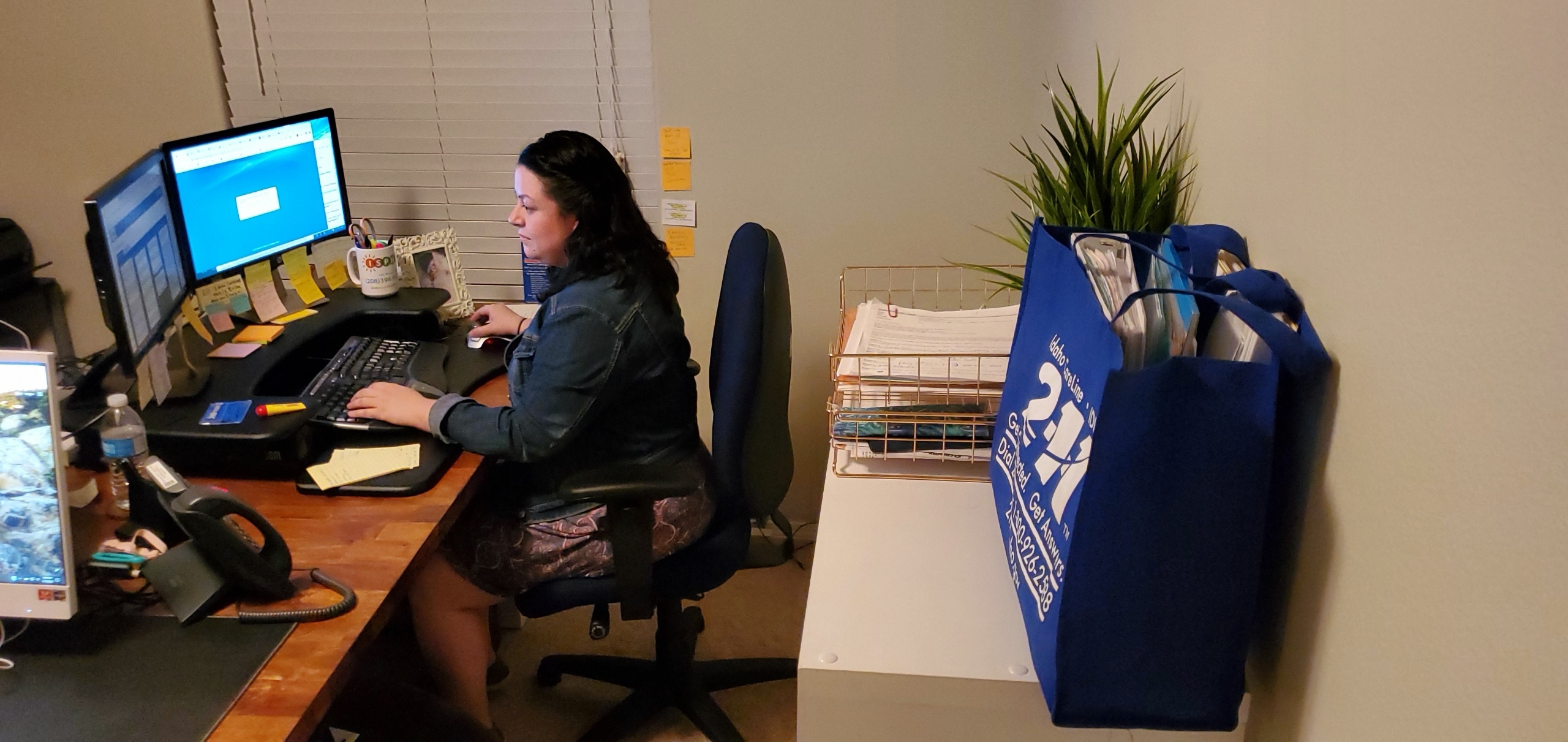
Erika Vasquez is a teleworking 2-1-1 CareLine Agent. CareLine calls are patched through to her home router through the Meraki system, so she can securely take 2-1-1 phone calls.
Erika Vasquez is a teleworking 2-1-1 CareLine Agent. CareLine calls are patched through to her home router through the Meraki system, so she can securely take 2-1-1 phone calls. Photo provided by Erika Vasquez

On a normal day at work answering calls on the 2-1-1 CareLine, Erika Vasquez sits at her work station in one corner of an open plan room. She is happily surrounded by the chatter of her six CareLine colleagues as they take back-to-back phone calls from Idahoans reaching out for information, resources, and services.

The calls are as varied as the services that Idahoans need from the department and beyond. Callers may be reaching out for help paying for rent, utilities, food, clothing, or other basic essentials. Callers might be fellow DHW employees, looking for phone numbers for department programs. Callers from the public are often looking for services offered by programs outside the department, such as social security or unemployment benefits.

When it comes to services and information available to Idahoans, Erika and her team know a bit about everything. And while it may seem they can help with most questions, they do have their limits. “We do get calls asking for the phone number for Burger King, but we won’t give them that. We might suggest they look for it on Google or in the phone book,” says Erika.

These phone conversations are punctuated by quick chats among the CareLine team members. Any time any of them need anything, they shout out to each other and help each other out. Perhaps they are stumped by a question. Perhaps they’ve just had a difficult conversation with a caller who was emotional and in crisis. Erika and her colleagues work together like clockwork, and support each other through every work day.

On any given day at work, Erika and her six colleagues each take around 60 to 100 calls per day. While the average call is one minute and forty seconds, calls can range from just one minute, to over 20 minutes. The team stagger their working hours to keep the CareLine open from 8 a.m. to 6 p.m. MST. This way, the line is open during business hours for all Idahoans, whether they are calling from the north, on Pacific Time, or from the south, on Mountain Time. Continue reading “A Day in the Life of Erika Vasquez, 2-1-1 CareLine Agent”