Listen up, Idaho: It’s plague awareness season!

Spring is a good time of year to enjoy the desert – it’s warm but not too hot when other parts of the state are still encased in snow. Birds are flying, lizards are sunning themselves, and ground squirrels and other animals are becoming more active. It’s a tempting respite from winter for Idahoans and our four-legged companions as spring settles in.

However, the desert in southern Idaho also contains rodents that might carry the fleas that carry the plague bacteria.  Plague can cause serious illness in people and pets if it’s not treated quickly.  It’s important to brush up on your knowledge of this deadly disease now so you can take precautions if you’re planning to spend time in the desert; particularly from March through July when ground squirrels are most active. Idaho has had no confirmed reports of plague so far this year, but the deadly disease was found in Idaho ground squirrels in 2015 and 2016.

Ground squirrel

Rodents that can become infected include ground squirrels (pictured), rats, and mice, and they readily die from the infection. Tree squirrels in Idaho are not known to carry plague. Continue reading “Listen up, Idaho: It’s plague awareness season!”
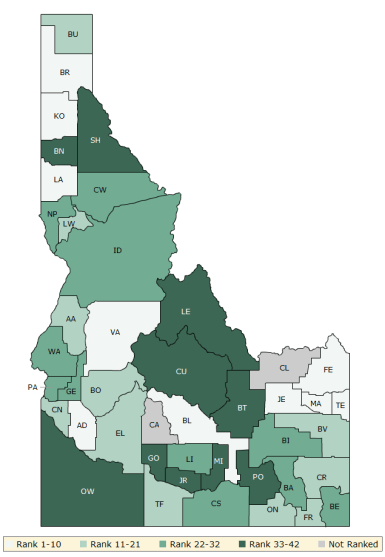
New county rankings show where we live matters to our health

2017 Health Outcomes - IdahoWe’ve all heard, “You are what you eat,” and the premise behind that saying is our health is significantly influenced by the choices we make, including diet and exercise.

But increasingly, research shows that the economic, social and environmental conditions in the communities where we live, work and play also factor into our ability to make healthy choices and live healthy lifestyles.

In general, living in Idaho provides the environments and opportunities for those healthy choices and lifestyles, from easy access to recreation for exercise, safe communities, family and social support systems and access to clinical care.

That’s according to the 2017 County Health Rankings and Roadmaps (CHRR), which were published today by the Robert Wood Johnson Foundation and the University of Wisconsin Population Health Institute. The annual county-by-county report analyzes multiple databases to evaluate overall health and well-being at the community level. It then ranks individual counties based on a calculation of overall health outcomes based on life expectancy and overall quality of life.

So how do Idaho counties compare to other Idaho counties in this latest survey? Continue reading “New county rankings show where we live matters to our health”

Be aware: Live poultry can carry Salmonella

chick-913804_640

It’s finally spring, Easter is April 16 and with that, many people might be thinking about buying chicks or ducklings as gifts or to replenish backyard poultry flocks. But in 2016, the U.S. Centers for Disease Control saw the largest number of Salmonella illnesses related to backyard poultry ever recorded by the agency. With that in mind, it’s a good time for a reminder about the precautions to take so you and your children don’t get sick from poultry carrying Salmonella bacteria.  Continue reading “Be aware: Live poultry can carry Salmonella”

Children act fast, but so do poisons

Most poisoning emergencies are unexpected and happen quickly in our homes. A majority of non-fatal poisonings involve children younger than six. And for adults, poisoning is the No. 1 cause of injury death in the United States. This week is National Poison Prevention Week, so it’s a good time to think about what you would do in a poisoning emergency.

Are young children most at risk for a poisoning accident?

In 2016, poisoning was the third leading cause of unintentional injury deaths among all Idahoans, with children younger than 6 being most at risk. It is extremely important for parents of small children to keep medications, laundry detergent, cleaning supplies, cosmetics and other potentially poisonous items out of their reach. The Nebraska Regional Poison Center, which receives all of Idaho’s poison emergency calls, had more than 13,000 calls in 2016 from Idaho residents. And the majority of those calls were from parents of children ages 6 and younger.  Continue reading “Children act fast, but so do poisons”

Idaho health officials urge consumers to avoid eating soy nut butters and granola linked to E. coli illnesses as recall expands

Sixteen people in nine states, including Washington and Oregon, have become seriously ill after eating a soy nut butter product linked to a nationwide illness outbreak and food recall. To date, no illnesses linked to the outbreak have been reported in Idaho, but Idaho health officials are urging Idahoans to double-check their cupboards for I.M. Healthy SoyNut Butter and other related products recalled after people who ate them became ill. These products may have been purchased in grocery stores in Idaho or on the Internet and distributed to schools, childcare centers, and other institutions.

State health departments, working with the Centers for Disease Control and Prevention (CDC) and the Food and Drug Administration (FDA), are investigating an ongoing outbreak of Shiga toxin-producing E. coli (STEC) O157:H7 illnesses reported from several states.

Any variety or size of I.M. Healthy SoyNut Butter, I.M. Healthy Granola, or Dixie Diner’s Club Carb Not Beanit Butter should not be served or eaten, regardless of the date of purchase or the date listed on the container.  Continue reading “Idaho health officials urge consumers to avoid eating soy nut butters and granola linked to E. coli illnesses as recall expands”

Protect yourself from mumps: Make sure your vaccinations are up to date

An outbreak of mumps in Washington State is a good reminder that although mumps is not very common in the United States, outbreaks and individual cases are happening all over our nation. As of Feb. 25, more than 1,000 people have been infected this year, according to the Centers for Disease Control and Prevention. That includes more than 360 cases in our neighboring state of Washington, and at least one case in northern Idaho. The Washington outbreak caused over 150 children to be excluded from school. Most of those children were unvaccinated and needed to be excluded for their own protection. Since immunization is your best protection against this contagious disease, it would be a good time to check vaccine records for yourself and your children to be sure you are up to date.

How would someone be exposed to it?

Mumps is caused by a virus. It spreads through saliva or mucus, so an infected person spreads it by:

  • Coughing, sneezing, or even just talking.
  • Sharing items you would put in your mouth like eating utensils and cups.
  • Touching things with unwashed hands that others might touch.

Continue reading “Protect yourself from mumps: Make sure your vaccinations are up to date”

Central Office staff wear blue

Colorectal Cancer is preventable with screening

Central Office staff wear blue
DHW staff wear blue in early March to highlight the need for colorectal cancer awareness.

March is National Colorectal Cancer Awareness Month, so you may hear about some of the famous people we’ve lost to this disease: movie star Audrey Hepburn, Peanuts comic creator Charles Schulz, “Bewitched” star Elizabeth Montgomery, and football great Vince Lombardi. But closer to home, screening for colorectal, or colon, cancer is something Idahoans age 50 and older should consider because it’s the second-leading cause of cancer deaths among men and women in the state. In fact, 1 in 20 Idaho adults will develop colon cancer and, sadly, chances are one-third of those diagnosed will die.

Who should be screened?
Generally, everyone starting at age 50 should get screened, and screening may begin earlier if you have a family history. Even if you are not experiencing symptoms, talk to your doctor about regular screening that may pick up growths before they become cancerous.  Continue reading “Colorectal Cancer is preventable with screening”

Brush up! Oral health is important to your overall health

February is National Children’s Dental Health Month, so it’s a good time to remind everyone – adults and children alike – that your oral health is important to your overall health. Practicing good oral health habits such as daily brushing and flossing and regular dental visits are easy steps toward keeping teeth and gums healthy at every age.

Why is oral health so important?

One of the main focus areas of the Oral Health Program at the Department of Health and Welfare is preventing tooth decay in children by providing oral health prevention programs across the state. These programs include school-based dental sealant clinics and fluoride varnish programs delivered in childcare centers and public health districts. Untreated childhood dental disease can put a significant financial burden on the family, cause poor performance in school, and lead to a lifetime of poor oral health.  Continue reading “Brush up! Oral health is important to your overall health”

Don’t dismiss a good night’s rest: Sleep is an important part of your overall health

Not getting enough sleep each night is associated with several chronic diseases, including diabetes, heart disease, obesity, and even depression. More than a quarter of the population of the United States say they occasionally don’t get enough sleep, while nearly 10 percent say they have chronic insomnia. Sufficient sleep each night is a necessity and should be a priority for everyone.

Why is it a bad idea to consistently not get enough sleep?

Sleeping less than 7 hours a night on a regular basis can affect a person’s ability to make good decisions and increases your chance of getting into a vehicle accident. Sleep deprivation also increases your risk for heart disease, diabetes and several other chronic diseases. It could even cause you to gain weight. And studies show that adults who get less than 7 hours a night increase their risk of dying at a younger age than those who get the recommended amount of sleep. Getting enough sleep is just as important to your overall health as regular exercise and healthy eating. Continue reading “Don’t dismiss a good night’s rest: Sleep is an important part of your overall health”

Wear Red for Women on Friday to raise awareness about heart disease and stroke


Friday is Go Red for Women Day. If you feel like supporting awareness about heart disease and stroke for women, wear red to show it. Heart disease and stroke causes 1 in 3 deaths for women each year, which means about one woman dies from the diseases every 80 seconds, according to the American Heart Association.

Heart disease is big problem for both men and women, isn’t it?

Nationally, heart disease is the leading cause of death for men and women. In Idaho, it is the second leading cause of death for men and women, after cancer. It’s a close second, though, and the statistics are alarming: 1 in 31 women dies from breast cancer each year, but heart disease kills 1 in 3.  Continue reading “Wear Red for Women on Friday to raise awareness about heart disease and stroke”