COVID Q&A: hydroxychloroquine, deaths, and dangerous hand sanitizers

Is hydroxychloroquine considered an effective treatment for COVID-19?

Hydroxychloroquine and chloroquine have not been shown to be safe and effective for treating or preventing COVID-19, according to the FDA, citing reports of serious heart rhythm problems in patients with COVID-19 treated with hydroxychloroquine or chloroquine.

Anyone considering using hydroxychloroquine should consult with a medical professional before beginning to use it. The U.S. National Institutes of Health recommends against using hydroxychloroquine except for people in clinical trials due to lack of evidence of clinical benefit and increased risk for abnormal heart rhythms and other side effects with the use of this medicine.

Continue reading “COVID Q&A: hydroxychloroquine, deaths, and dangerous hand sanitizers”

COVID-19: A Q&A

In our endless desire to make sure Idahoans have accurate, current, and relevant information about COVID-19, we’re continuing to answer questions we have received through the Department of Health and Welfare’s (DHW) social media accounts, in emails, and in our daily lives as we all live with the coronavirus in our communities. Here are some we’ve collected recently.

Q: I’ve heard that hospitals make more money treating COVID-19 patients, so they are labeling more patients as COVID-positive than they are actually treating for COVID-19. Is this true?

A: This is not true. There is a false rumor circulating that hospitals are misrepresenting COVID patient data to increase federal reimbursements for patient care. It is true that the Coronavirus Aid, Relief, and Economic Security (CARES) Act increased reimbursements to hospitals for Medicare patients with COVID-19 due to the high cost of COVID-19 patient care.

However, it is not true that healthcare providers have an incentive to misrepresent a patient’s COVID-19 status. To begin with, a misrepresentation of a patient’s COVID-19 status would be fraudulent, exposing the provider to civil and even criminal liability. 

Second, the clinicians who decide whether to diagnose patients with COVID-19 have no economic incentive to do so. The way physicians in hospital systems are compensated for the services they provide is not based on what Medicare or other payers reimburse the hospital system for the care. A diagnosing physician is paid the same amount for services provided to a patient with or without a COVID-19 diagnosis. 

Third, Medicare’s increased reimbursements typically do not cover the increased costs of providing care to COVID-positive patients. COVID-positive patients often suffer more intense symptoms and potential complications than non-COVID patients. These patients often require a combination of medications and sometimes a ventilator for many days to support breathing. Even COVID-19 patients whose disease does not become more severe require more expensive care, including increased use of personal protective equipment, seclusion, and more rigorous disinfection routines. The modest increase in Medicare reimbursement does not come close to covering the cost of care. 

Finally, Medicare is the only payer that has increased hospital reimbursement for COVID-positive patients. Therefore, for the vast majority of patients under age 65, there is no increase in funding for hospitalized COVID-19 patients.

Continue reading “COVID-19: A Q&A”

There’s a path forward for families eligible for P-EBT program: An update from DHW Director Dave Jeppesen

The state of Idaho is participating in the Pandemic Electronic Benefit Transfer (P-EBT) Program, but it took some work to get to a path forward.

The P-EBT provides eligible families with a one-time payment for each child who previously received free or reduced-price meals at school. The Department of Health and Welfare does not administer the school lunch program. In order for Idaho to implement the P-EBT program, DHW and the Department of Education had to work out data share agreements to make sure data could be shared between the departments. Conversations between the two agencies started in earnest in early June. Because each individual school district owns the data for families eligible for the school lunch program, we worked together to ensure we were able to get all of the information in a format we could use from local public school districts to implement the program.

Now that the path forward has been determined, DHW and the Department of Education have submitted their plan to the U.S. Department of Agriculture for approval, and we have full confidence that our plan will be approved. When it is approved, we will get P-EBT payments to eligible families as soon as possible.

Idaho remains in Stage 4 of the Idaho Rebounds Plan for two more weeks

During Gov. Brad Little’s press conference on Thursday, he announced that Idaho would remain in Stage 4 for the next two weeks. Although we are staying in Stage 4, there is good news for Idahoans because:

  • Idaho has sufficient healthcare workers, PPE, ventilators, and ICU beds, and we are meeting the demands for testing our healthcare workers statewide. 
  • The state has downward trends in overall case counts as well as our percent-positivity rate.
  • Emergency room visits from those with COVID-like symptoms are declining.

Gov. Little added overall hospital admissions statewide to the list of metrics used to examine Idaho’s situation every two weeks and said those numbers need to be on a downward trend. He also noted that in some of the state’s hot spots, we are starting to see the benefits of the measures that local public health officials and mayors have put in place such as mask/cloth face covering orders or resolutions.

Continue reading “There’s a path forward for families eligible for P-EBT program: An update from DHW Director Dave Jeppesen”

More emergency funding is available for childcare providers in Idaho

The Idaho Department of Health and Welfare (DHW) has launched Phase 2 of the Idaho Child Care Emergency Grant. This is a new opportunity open to all eligible childcare providers, including those who may have previously received grant funding from DHW.

Some basic details about this phase of the Idaho Child Care Emergency Grant include:

  • Applications will only be accepted via email to ChildCareGrant@dhw.idaho.gov through Aug. 31.
  • To qualify, a childcare program must be participating with Idaho Child Care Program and/or are licensed and open and providing full-time childcare.
  • Phase 2 funding should be used to support staffing costs, cleaning and janitorial supplies and services, business operations, and transportation.  
  • This is not a “first-come, first-served” grant opportunity. All eligible applicants will receive at least two monthly award payments.
  • Each applicant will be responsible for the recordkeeping of all required grant documentation and proof of eligible expenditures.
  • Phase 2 grants will be distributed in equal monthly payments, beginning in August until the funds are depleted. Total grant amounts will be determined by provider type, as follows:
Phase II Idaho Child Care Emergency Grant
 Large centers (Licensed capacity of 25+ children)  $ 5,000
 Small centers (Licensed capacity of 13-24 children)  $ 2,500
 Licensed group homes (7-12 children)  $ 1,000
 Family childcare homes (Up to 6 children)  $    500
Continue reading “More emergency funding is available for childcare providers in Idaho”

Face coverings are protective, research shows

We have received several questions about whether face coverings actually protect us from the virus that causes COVID-19.

The evidence from many different sources is clear – face coverings are protective, especially when they’re used with the other recommended guidelines of keeping 6 feet between you and everyone else in public, washing or sanitizing your hands frequently, and staying home if you’re sick. Here’s a list of articles and studies and reports that have slight variations on the same theme — #MaskUpIdaho.

Continue reading “Face coverings are protective, research shows”

Wear a mask for your neighbors and your community: A call for action from DHW Director Dave Jeppesen

STAY THE COURSE TO SLOW THE SPREAD

The continued increase of COVID-19 cases in Ada County, and other areas of the state, is troubling. On social media, we are being asked “What can we do to slow the spread?”  In the absence of a vaccine or therapeutic interventions, the answer is simple, and it bears repeating:

  • Keep at least six feet between you and others in public
  • Wear face coverings in public places 
  • Stay home if you are sick
  • Wash your hands often
  • Cover coughs and sneezes
  • Disinfect surfaces and objects regularly

WEARING A MASK IS AN ACT OF LOVE AND RESPECT FOR OTHERS

During the last few months, the subject of wearing a mask has been hotly debated in public forums (and especially on social media) throughout the United States. In Idaho, some cities and counties are requiring the wearing of masks in public places when it is difficult to maintain six feet of physical distancing. Many businesses nationwide are requiring masks upon entry. We support those efforts.

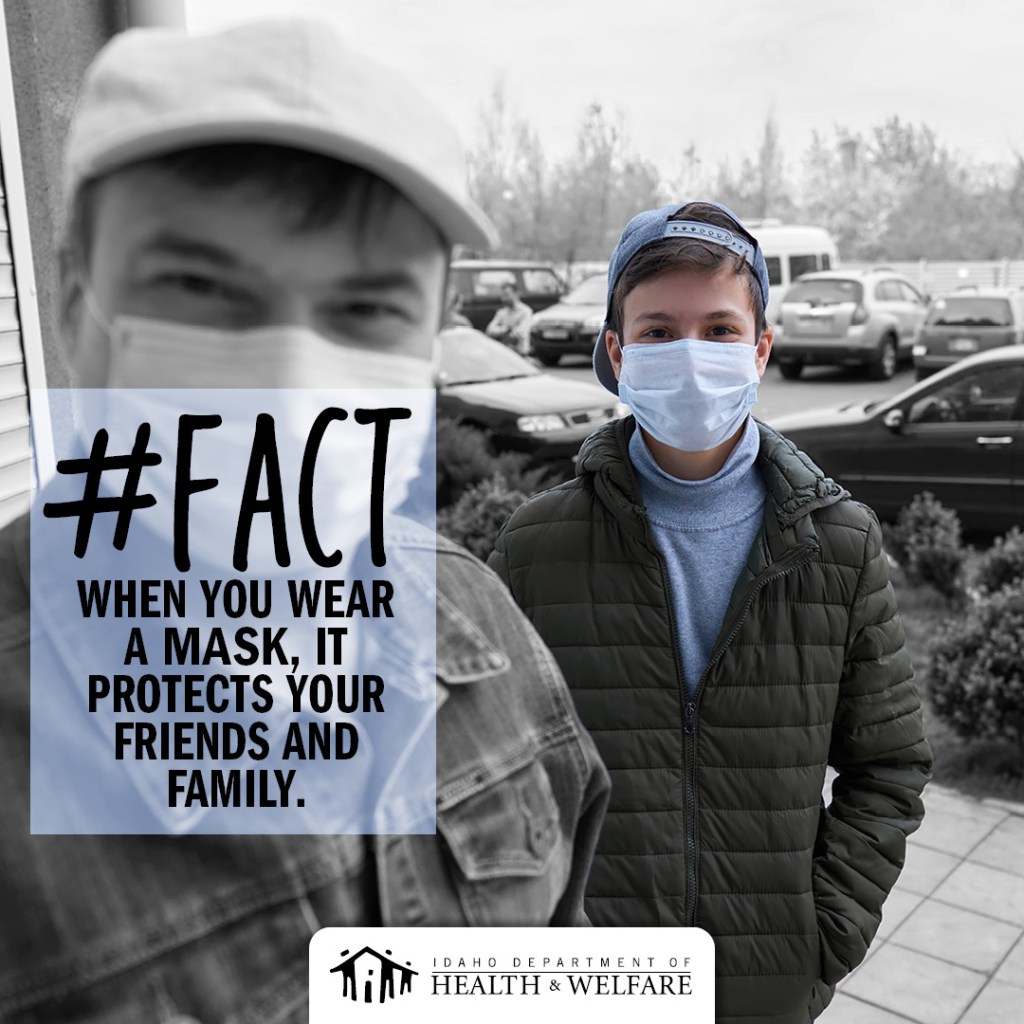
At DHW, we highly recommend wearing masks or cloth face coverings. It helps slow the spread of COVID19 and shows your concern for your friends, neighbors, and community. There is mounting evidence that masks do prevent the spread of the virus, if we all wear masks or cloth face coverings properly.

Continue reading “Wear a mask for your neighbors and your community: A call for action from DHW Director Dave Jeppesen”

COVID-19: Facts vs. Fiction

There is a lot of COVID-19 information available through social media and other communications channels. Some of it is helpful and factual, and some of it is opinion or speculation. And some is just plain false. We want to help you separate the COVID-19 facts from fiction as you navigate through this pandemic.

Is wearing a mask or cloth face covering really helpful? The evidence is clear — cloth face coverings reduce the spread of COVID-19. They serve two purposes: to protect the public from those who may be infected with COVID-19 and to protect those infected with COVID-19 from spreading the disease to others.

Wearing a mask is most effective when everyone does it, and it also shows respect and concern for your neighbors and community. Masks are appropriate when physical distancing of at least six feet is not possible.

Cloth face coverings should not be placed on young children under the age of 2, anyone with difficulty breathing, anyone who is unconscious, incapacitated, or unable to remove the covering without assistance.

Does COVID-19 more severely affect older adults? Yes. According to the Centers for Disease Control and Prevention, as you get older, your risk for severe illness from COVID-19 increases. For example, people in their 50s are at higher risk for severe illness than people in their 40s. Similarly, people in their 60s or 70s are, in general, are at higher risk for severe illness than people in their 50s. The greatest risk for severe illness from COVID-19 is among those aged 85 or older.

There are also other factors that can increase your risk for severe illness, such as underlying medical conditions. By understanding the factors that put you at an increased risk, you can make decisions about what kind of precautions you should take in your daily life.

Continue reading “COVID-19: Facts vs. Fiction”

Let’s never stop, Idaho! New programs and services offer behavioral health assistance during the pandemic

Hope is the thing with feathers that perches in the soul – and sings the tunes without the words – and never stops at all.” Emily Dickenson

With the COVID-19 pandemic now firmly sitting on our doorstep, most of us are experiencing our first ever black swan event – a once in a generation major occurrence that has come as a complete surprise, challenges our assumptions and ways of life, and tests our collective strength. While history shows us that all pandemics will come to an end, this one does feel infinite.

Adjusting to the “new normal” is challenging, tiring, and it stretches our perceived psychological limits. We’re all feeling pressure and stress about the economy, our health, our relationships with family and friends, and our jobs amid large spikes of COVID-19 cases across some areas of the state. It’s easy to feel like maybe the best times are behind us.

But during quiet moments of despair we might overlook how much more we are connecting with friends and family via technology, the simple beauty and wonder in our own backyards at dawn and dusk, and the new and surprising habits and traditions we are creating that bring us joy and pleasure.

Although it can often feel like it, you are not alone. The Division of Behavioral Health (DBH) in the Department of Health and Welfare is continually thinking about how to better serve the evolving needs of mental health providers and the public. DBH created a statewide COVID19 Strike Team in April that meets daily to address our specific state needs during the growing public and behavioral health emergency related to the pandemic.

Thanks to funding from our federal partners, DBH is now implementing an emergency grant offered by the Substance Abuse and Mental Health Services Administration (SAMHSA) under the federal Department of Health & Human Services, that is allowing us to offer important programs to help Idahoans. 

Continue reading “Let’s never stop, Idaho! New programs and services offer behavioral health assistance during the pandemic”

Have a safe Fourth of July weekend: A message from DHW Director Dave Jeppesen

This upcoming holiday weekend is a test for all of us. Can we enjoy our beautiful state, spend time with family, take a vacation, and still keep ourselves and communities safe from the spread of COVID-19?

The answer is: We can. I hope you will remember to do your part this weekend to keep Idaho open and protect our vulnerable loved ones. It’s a personal choice, but I hope you take that choice seriously. Because COVID-19 is no joke.

We need to slow the spread

We know that the majority of new cases are in Ada County and, in particular, there is a surge in new cases among young adults. Central Health District made the tough but appropriate and critical decision to move Ada County back to Stage 3 through a new Order.

Because of the continued increase in cases among young adults in many counties across the state, it is more important than ever to encourage young adults to take recommended precautions to protect those who are vulnerable in our state. We need to protect our parents and grandparents. We need to protect those with immunosuppressed systems. We need to show our families, friends, and communities that we understand we are all in this together, and we will do whatever we can to slow the spread of COVID-19.

Young adults may show very few symptoms and may even be asymptomatic, but they can spread the virus to others who may be more vulnerable. Let’s work together to keep our families safe. It really does take all of us.

Continue reading “Have a safe Fourth of July weekend: A message from DHW Director Dave Jeppesen”

DHW Director Dave Jeppesen: Stage 4 pause means it’s more important than ever to follow the guidelines

Gov. Brad Little announced Thursday that Idaho did not meet the metrics needed to move out of the final stage of the Idaho Rebounds plan. Idaho will stay in the final stage of the Idaho Rebounds plan for at least another two weeks.

Idaho did not meet the epidemiologic and healthcare criteria to advance past Stage 4:

  • The number of reported cases from June 10-25 trended upward instead of downward.
  • The percent of positive tests from June 8-21 trended upward instead of downward.
  • The average percent positive for the prior 14-day period was greater than 5-percent at 5.12-percent.
  • The number of healthcare workers reported with COVID-19 from June 10-23 trended upward, and the average number of healthcare workers reported having COVID-19 per day was greater than the standard of 2.

He also announced that the state’s COVID-19 response will transition to a more regional approach as the number of cases in some counties has increased significantly, but several others have had no reports of COVID-19 cases. The seven local public health districts across the state are continually evaluating the criteria at the local level and will announce any changes in moving forward.

What this all means is that it remains critical for everyone – especially those who are 18-29 years old — to follow the recommended guidelines and stay home if you’re sick, wear a face covering and keep six feet apart in public, and wash your hands frequently. It’s also a good idea to avoid large gatherings of people to help reduce your personal risk of getting COVID-19.

The ultimate goal is to slow the spread of COVID-19 and keep us within the capacity of our healthcare system so people who do need hospital-level care can get it when they need it.

Idaho’s success depends on us all.

Continue reading “DHW Director Dave Jeppesen: Stage 4 pause means it’s more important than ever to follow the guidelines”