February food stamps benefits to be issued in January

Because of the federal government shutdown, the Department of Health and Welfare will be issuing February benefits for the Supplemental Nutrition Assistance Program (SNAP) on Sunday, Jan. 20.

All households approved and re-evaluated by Tuesday, Jan. 15, will receive their February food stamps on Jan. 20. Households that complete a re-evaluation and are approved after Jan. 15 for February will receive their benefits on their regular issuance date. The department is continuing to accept and process applications normally through January and February and doesn’t anticipate any delays in SNAP issuance.

Everyone who is eligible for SNAP benefits in February will receive their benefits. However, households that receive their February benefits in January will not receive an additional issuance in February. Recipients are encouraged to budget their food stamps to last until they receive their March benefits.

“This is a fluid time for federal government services,” said Julie Hammon, administrator of the Division of Welfare. “Until we know more, please consider a donation to your local food banks and pantries – February will be tough month for many because of the length of time between benefits.”

Letters to recipients were sent by first class mail on Wednesday, Jan. 16. Department staff also have been communicating with grocery stores and other community partners on the schedule change.

If recipients have questions about the early issuance or SNAP benefits in general, they can call the Idaho CareLine by dialing 2-1-1 in Idaho or the Self-Reliance call center at 1-877-456-1233.

The Supplemental Nutrition Assistance Program is administered in the Division of Welfare in the Idaho Department of Health and Welfare. Benefits are paid entirely with federal funds. Learn more about the program here.

Media Contact:  Niki Forbing-Orr
Public Information Manager
(208) 334-0668 or Niki.Forbing-Orr@dhw.idaho.gov

 

High radon levels in Idaho can put your health at risk – order a test kit today

High radon levels have been found in homes in every Idaho county. Radon, which is odorless, tasteless, and invisible, is the second-leading cause of lung cancer, behind smoking, and is a serious health threat in Idaho. Nearly 40 percent of Idaho homes tested for radon have higher-than-recommended levels.

“Since we know radon causes lung cancer, we recommend that you test your home to learn if it has high levels of this harmful gas,” said Dr. Colby Adams, environmental health director for DHW’s Division of Public Health. “Testing a home for radon is easy and inexpensive. Home radon levels are higher during winter months, which is why January is National Radon Action Month and a good time to test. If testing reveals that your home has high radon levels, you can take steps to remove the gas and protect you and your family.” Continue reading “High radon levels in Idaho can put your health at risk – order a test kit today”

Have you tested your home for radon yet? If not, now is the time to do it!

Radon gas is the leading cause of lung cancer for nonsmokers, and the only way to know it’s in your home is to test for it. It is an odorless, tasteless gas that has been found in 40 percent of the homes in Idaho that have been tested. It’s a very serious health issue in Idaho, and it causes more than 21,000 deaths a year in the United States.

How does radon get into homes?

Radon is a naturally occurring gas that comes from the breakdown of uranium. It seeps from soil into homes and buildings through crawl spaces, and cracks and openings in foundations. It tends to build up the most in winter, when people have their homes closed up against the cold. That’s why now is a good time to test for it in the lowest level of your home where you spend time. Continue reading “Have you tested your home for radon yet? If not, now is the time to do it!”

Free DATA 2000 Waiver training available in two classes in January and February

Medication-assisted treatment is the use of FDA-approved medications in combination with counseling and behavioral therapies to provide a “whole-patient” approach to the treatment of Opioid Use Disorder. In Idaho, the two primary medications used in medication-assisted treatment are methadone and buprenorphine [suboxone].

To prescribe buprenorphine/suboxone, qualified physicians, physician assistants, and nurse practitioners must complete a training and apply for a DATA 2000 Waiver, also called an X-license, to treat Opioid Use Disorder with approved products in any setting in which they are qualified to practice. This required training is currently being offered for free in Idaho. Continue reading “Free DATA 2000 Waiver training available in two classes in January and February”

Idaho Poison Center: Lock medications up, and other tips for safe holidays

During the hustle and bustle of the holidays it is easy to overlook items in your home that could cause a poisoning. The number of poisoning incidents involving children typically increases during the holiday season. The Idaho Poison Center offers a few tips on how to keep your holidays safe this year: Continue reading “Idaho Poison Center: Lock medications up, and other tips for safe holidays”

Food safety: How to make sure your holiday treats don’t make anyone sick

HolidayFoodSafetyCDC

Several food safety alerts and recalls this season have made it difficult to know what’s safe to eat. Even though we can’t do much personally to control those national events except to pay attention and not consume recalled products, we can take some basic food safety actions, both as a guest and as a host, so we don’t add insult to injury. Nearly 1 in 6 Americans get sick each year from contaminated food, according to the Centers for Disease Control and Prevention. Reducing that number by just 10 percent would keep nearly 5 million people from getting sick each year.

What is the most common cause of food poisoning?

There are more than 250 agents that can cause foodborne illness including viruses, bacteria, parasites, toxins, and foreign objects. Norovirus is the most common virus to cause food poisoning, while salmonella is the most common bacterial cause and results in more deaths than infections with other bacteria.

Are there certain foods we should avoid at gatherings?

Contaminated leafy greens, such as romaine lettuce, and undercooked poultry are the main culprits for foodborne disease. But illness can come from lots of different types of foods, including raw milk, raw eggs (as in eggnog), and undercooked meat. You should wash your hands with soap and water before and after preparing, serving, or eating food, and always cook foods to a safe internal temperature. Also, be sure to thoroughly wash fruits and vegetables before you serve or eat them. Continue reading “Food safety: How to make sure your holiday treats don’t make anyone sick”

Wash your hands often, because clean hands keep you from getting sick (and spreading germs!)

handwashing_456px

Now is a good time to be reminded about how important it is to do something very simple for your health: Wash your hands, and wash them often. It’s one of the best things you can do (besides getting immunized) to avoid getting sick or spreading germs to others.

Let’s start with the basics. When should you wash your hands?

After using the toilet is No. 1, but in general it’s a good idea to wash your hands when you get home or are preparing food or are ready to eat. You should also wash up before and after caring for someone who is sick, after changing a diaper, after holding or petting an animal, and after blowing your nose or coughing or sneezing into your hands.

Is there a right way to wash your hands?

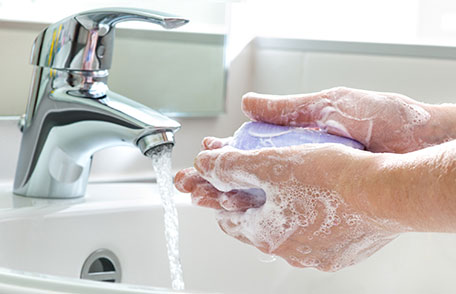
There are essentially five steps to washing your hands the right way: Wet, Lather, Scrub, Rinse and Dry. You should use soap and water and rub your hands together to lather the soap. Be sure to scrub the backs of your hands, between your fingers and under your nails each time you wash. You need to vigorously rub your hands together for at least 20 seconds, which also is the length of the “Happy Birthday” song from beginning to end, twice. Hum it to yourself and then rinse your hands under running water and dry them with a clean towel or allow them to air dry. Continue reading “Wash your hands often, because clean hands keep you from getting sick (and spreading germs!)”

A Closer Look At Your Health: Learn how to prevent or manage type 2 diabetes

Diabetes is a huge health problem for many Idahoans: Nearly 600,000 Idaho adults have prediabetes and are at risk for developing type 2 diabetes. November is Diabetes Awareness Month, so it’s a good time to learn what you can do to prevent the disease or get help managing it.

How do you find out if you have it?

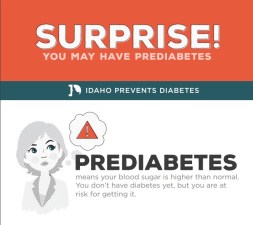
PrediabetesInfoGraphicThe American Diabetes Association recommends that all adults over the age of 45 be screened for diabetes every three years. Catching it early can prevent complications such as heart disease, stroke, and blindness. Many insurance plans, including Medicare and Medicaid, will pay for the screening with the recommendation from a healthcare provider.
Is it possible to have prediabetes but still prevent type 2 diabetes?

Prediabetes happens when your blood glucose levels are higher than normal but not high enough to be diagnosed as type 2 diabetes. For some people, early diagnosis and intervention can return blood glucose levels to the normal range. People who have been diagnosed with prediabetes are eligible to participate in a Diabetes Prevention Program, which are offered throughout the state. The program will help you take charge of your health to prevent or delay type 2 diabetes. Find out your risk for developing prediabetes and learn more about the Diabetes Prevention Program by going to www.diabetes.idaho.gov. Continue reading “A Closer Look At Your Health: Learn how to prevent or manage type 2 diabetes”

SWITC complaint is unsubstantiated, survey says

The Idaho Department of Health and Welfare is pleased to announce that a complaint investigation at Southwest Idaho Treatment Center has been completed, and the conclusion of the third-party survey team is that the complaint is unsubstantiated.

“I am so pleased to see our efforts recognized in the outcome of this survey,” said SWITC Administrator Jamie Newton. “We have been working diligently to update policies, procedures, and practice to address the issues we discovered in the summer of 2017. This is good news.” Continue reading “SWITC complaint is unsubstantiated, survey says”

Idaho Rural Health Association honors DHW’s Mary Sheridan as an Idaho Rural Health Hero

1116_MarySheridanAwardCROPPED
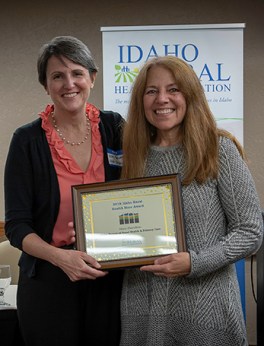
Mary Barinaga, MD, president of the Idaho Rural Health Association board, presents an Idaho  Rural Health Hero Award to Mary Sheridan, bureau chief of Rural Health and Primary Care in the Division of Public Health, Idaho Department of Health and Welfare.

Mary Sheridan was one of eight Idaho healthcare professionals to receive an Idaho Rural Health Hero Award at the Idaho Rural Health Association’s 2018 Annual Meeting and Awards Reception on Nov. 7.

The awards are given a week before National Rural Health Day in Idaho (November 15th) to recognize rural health educators, community advocates, healthcare providers and program administrators who demonstrate outstanding service and dedication to rural communities.  Nominations described the many contributions of this year’s awardees as advocates, communicators, educators, collaborators and innovators.

Mary has been a key public figure in rural health policy and innovation since joining the Idaho Department of Health and Welfare in 1995. She is a member of the Idaho Healthcare Coalition appointed by the Governor and winner of the 2017 National Organization of State Offices of Rural Health Award. She is passionate about understanding rural health issues and seeking resources to help address unmet needs. Continue reading “Idaho Rural Health Association honors DHW’s Mary Sheridan as an Idaho Rural Health Hero”