Tips for safely canning your garden harvest and avoiding botulism

Canning your garden harvest is a great way to preserve it and share it with family and friends, but it can be risky if it’s not done correctly. I know it’s early yet, but harvest time will be here before we know it, and it’s important to be knowledgeable about proper canning techniques so you can make sure your home-canned vegetables aren’t contaminated by the germ that causes botulism.

What is botulism?

Botulism is a rare but serious illness caused by a bacteria that produces powerful toxins that can lead to serious illness, including paralysis, and even death. The bacteria produce hardy spores that can survive in soil. Fruits, meats, fish, and vegetables could be contaminated with the bacterial spores before canning. The spores can survive, grow as bacteria, and produce toxins in improperly canned jars of food. It can be deadly to take even a small taste of food that has this toxin in it.  Continue reading “Tips for safely canning your garden harvest and avoiding botulism”
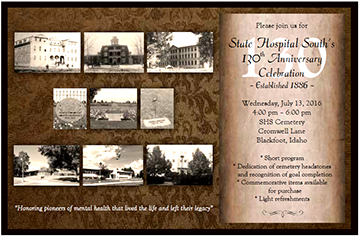
State Hospital South celebrates 130 years of service

OLYMPUS DIGITAL CAMERA
State Hospital South in Blackfoot will mark 130 years of service during a celebration Wednesday, July 13, in the cemetery, which now has a headstone for each grave.

State Hospital South in Blackfoot has come a long way since it was established in July 1886 as the Idaho Insane Asylum with 36 “inmates” (26 men and 10 women) who were transferred from an asylum in Oregon.

SHS_AnniversaryInviteWebIt’s been 130 years since the hospital first opened its doors and offered a place to live and work for nearly 29,000 patients with mental health issues over the years. The hospital will celebrate all of those years of service from 4-6 p.m. on Wednesday, July 13, at the State Hospital South Cemetery on Cromwell Lane in Blackfoot, Idaho. The celebration will include a dedication of the final set of headstones to be installed in the cemetery, as well as presentations from students who are related to hospital staff. They will share stories about some of the patients who lived at the hospital between 1891 and the early 1980s and who are buried in the cemetery. Continue reading “State Hospital South celebrates 130 years of service”

DHW is compiling list of free ultrasound providers, will be available Aug. 1

The Department of Health and Welfare is in the process of compiling requests to be included in a list of providers, clinics and other facilities that offer free ultrasounds to pregnant women in Idaho who are contemplating abortion.

Providers must fill out a form to be included on the list through July 29. The final list will be available online and in hard-copy form on Aug. 1. Hard copies of the list will be provided whenever resources are given to a woman seeking an abortion.

Starting in 2017, the list will be updated annually on Jan. 1. The program must receive all requests by Dec. 15 to be included in the annual update. Requests must be made using the form on this website, and providers must make the request annually to stay on the list.

For more information, please visit www.abortioninfo.dhw.idaho.gov.

Rabies in Idaho: Leave bats alone!

(Note: A Closer Look At Your Health airs most Tuesdays at 6:50 a.m. on KBOI News Radio 670. This is an edited transcript of the segment from June 28. Since then, another bat has tested positive for rabies, bringing the grand total to two so far this summer.) 

Rabid bats are found every year in Idaho, mostly between May and November. We’ve had one report of a rabid bat this year; it was found in Meridian. There likely will be more, so it’s a good idea to remind your kids that if they see a bat they should leave it alone and tell an adult.

Why is it important for children to leave bats alone?

Rabies infection is 100-percent fatal for people and animals who do not get timely medical attention. A couple of people in the United States die each year from it, usually because they’ve been bitten or scratched by bat and didn’t seek medical attention right away. The bite of a bat can be so small that people don’t realize the risk associated with it. Continue reading “Rabies in Idaho: Leave bats alone!”

Tips for staying healthy at the fair this summer

(Note: A Closer Look At Your Health airs at 6:50 a.m. most Tuesdays on KBOI News Radio 670. This is an edited transcript of segment that aired this morning, July 5.) 

Idaho fairs and festivals are starting across the state, which is exciting because they offer some of the best fun of the summer! But they also offer up some health challenges, which we hope you’ll keep in mind when you and your family head off to the fairgrounds. So today we’re going to talk about some things you can do to stay safe and healthy, especially when you’re visiting the animal exhibits or munching on the food.

Let’s start with animal exhibits. What should we know about those?

It’s important to keep in mind that seemingly healthy animals can sometimes carry germs that might make us sick. Small children should be supervised at all times in animal exhibits. They shouldn’t be allowed to put their hands or objects (such as pacifiers) in their mouths after interacting with the animals and before washing up. Simply washing hands as well as anything else that falls on the ground after being in the animal barns or the petting zoo will go a long way toward protecting yourself and your family from diseases spread by animals. You should also be aware that even animals at the fair can bite, kick, and scratch, so approach them with care to avoid getting hurt.  Continue reading “Tips for staying healthy at the fair this summer”

Your child broke a glow stick? Call the Idaho Poison Center

Most parents recognize the fact that fireworks and small children just don’t mix.  Glow sticks and glow jewelry are a safer alternative to bottle rockets and sparklers that can cause serious burns.  But these brightly colored glow products are soft and pliable and easily broken open, especially by children.

A child with a glowing mouth can cause some anxious moments for parents, but it’s typically not worth a trip to the emergency room. Even so, parents should call the Idaho Poison Center at 1-800-222-1222 to be sure. Continue reading “Your child broke a glow stick? Call the Idaho Poison Center”

West Nile virus discovered in Southwest Idaho

Mosquitoes infected with West Nile virus (WNV) have been detected this week in Canyon and Payette counties, prompting public health officials to remind people to take precautions to fight the bite. The positive mosquitoes are the first detected in the state this year.

“West Nile Virus can cause serious illness so it is very important that people take precautions to avoid bites and mosquito-proof their homes,” says Dr. Leslie Tengelsen, from the Idaho Division of Public Health. “With our recent warm weather we could see an increase in mosquito activity over the holiday, so we urge people to be careful.” Continue reading “West Nile virus discovered in Southwest Idaho”

New schedule means most food stamps recipients will not receive their benefits on Friday

Big changes begin on Friday for the way food stamps benefits are delivered.

Starting then, food stamps will be delivered over the first 10 days of the month rather than only on the first. Because of this, most recipients will not receive their benefits on the first and will have to wait up to 9 additional days before their benefits are available, depending on the last number of the primary applicant’s birth year.

“It’s critically important for recipients to know when they will receive their benefits so they have enough food,” said Lori Wolff, administrator for the division of Welfare. “We have several options in place so they know when those benefits will load up on the cards and are available to use. We hope they have been using those tools and are aware of the change.”  Continue reading “New schedule means most food stamps recipients will not receive their benefits on Friday”

Refugees with active TB were not contagious

A recent news story reports that Idaho has resettled seven refugees with active tuberculosis (TB) between 2011 and 2015. While that is accurate, it’s important to note that those refugees were not infectious and could not spread the tuberculosis infection to other people.

They all had abnormal chest X-rays, which is typically how they are screened for TB in other countries, but they tested negative for contagious disease in three separate sputum cultures after they arrived in Idaho. Even so, they all received immediate treatment and were monitored by public health officials to make sure any TB would be killed that their lungs might harbor.  Continue reading “Refugees with active TB were not contagious”

Safety first for the Fourth!

The Fourth of July is just around the corner, so it’sFireworks high time to refresh our knowledge of the precautions we should take if we’re lighting off fireworks. We’d really like for all Idahoans to make it through the weekend without causing any fires, injuries, or burning your neighborhood down.

Aren’t many fireworks illegal?

Yes, they are… Before you buy any fireworks, you should check with your city for a list of those that are legal. Generally, any firework that leaves the ground or explodes is probably going to be illegal because they are dangerous. If you’re lighting fireworks, point them away from homes, and keep them away from brush, leaves and flammable substances.  Continue reading “Safety first for the Fourth!”