Idaho public health officials work closely with long-term care facilities to help slow the spread of COVID-19

Like other states around the country, Idaho has unfortunately had cases and deaths related to COVID-19 in long-term care facilities since the start of the pandemic in Idaho in mid-March.

The virus that causes COVID-19 is particularly dangerous for the vulnerable residents of those facilities, which include skilled nursing homes, assisted living and memory care, and intermediate care facilities. Idaho has about 400 of those facilities.

Public health officials at the state and local public health districts continue to work closely with long-term care facilities throughout the state to make sure they have access to testing, personal protective equipment (PPE), and the latest guidance for how to slow or stop transmission of COVID-19 for these highly vulnerable people. Much of this guidance has been posted at https://coronavirus.idaho.gov/ltc/.

But it has been challenging. The virus that causes COVID-19 is new, and the world is still learning how to treat and contain it. It is such a contagious virus that it can spread easily among vulnerable residents in congregate living facilities. A confirmed COVID-positive resident in a facility is not necessarily a reflection of the quality of care or the performance of that facility.

Continue reading “Idaho public health officials work closely with long-term care facilities to help slow the spread of COVID-19”
DHW Director Dave Jeppesen: Staying Safe During Stage 3 and Contact Tracing

Thanks to all Idahoans, we are now halfway through Stage 3. Rebound.idaho.gov has numerous protocols available to help businesses reopen safely, including guidance for safe campgrounds, outfitting services, agricultural workers, indoor movie theatres, and much more.

Although it has been said many times, it’s important to remind everyone that the continued reopening of Idaho depends on you. Please follow the recommended precautions:

  • Keep at least six feet between you and others in public
  • Wear face coverings in public places (the Centers for Disease Control and Prevention advises the use of simple cloth face coverings to slow the spread of the virus and help people who may have the virus, and do not know it, from transmitting it to others)
  • Stay home if you are sick
  • Wash your hands often
  • Cover coughs and sneezes
  • Disinfect surfaces and objects regularly

With your support and commitment, we will be able to continue the reopening of Idaho.

Continue reading “DHW Director Dave Jeppesen: Staying Safe During Stage 3 and Contact Tracing”

Contact tracing in Idaho is important to stopping the spread of COVID-19

If someone you know or had spent some time with recently tested positive for COVID-19, wouldn’t you want to know about that?

Connecting with individuals who may have been exposed to the virus that causes COVID-19 is a critical piece of Idaho’s plan to safely reopen and contain the spread of disease. As more people are tested, more disease will be discovered, and the spread of the disease will need to be managed and contained in safe, responsible ways. This process is called contact tracing.

Epidemiologists in Idaho’s seven local public heath districts have been organizing and leading the effort to notify people of their possible exposure to COVID-19 since the beginning of the outbreak. This is a process public health is familiar with and has used to contain communicable diseases for decades.

Here’s how it works.

When someone is diagnosed with certain infectious diseases that are reportable under state law, laboratories and healthcare providers report basic information, such as name and birthdate, of the diagnosed person (known as the “index case”) to the local and/or state public health agency.

Continue reading “Contact tracing in Idaho is important to stopping the spread of COVID-19”

Idaho Child Care Emergency Grant provides more than $1.5 million for childcare providers, applications still being accepted

Idaho has approved 155 applications for the Idaho Child Care Emergency Grant since May 1, totaling more than $1.5 million in assistance to operating childcare businesses. 

“These investments are vital to Idaho’s infrastructure as we reopen businesses and families head into summer activities,” said Ericka Rupp, Child Care Program manager in the Department of Health and Welfare (DHW). “Access to safe, quality childcare and after-school programs for families is a critical component of a successful statewide recovery.”

“We want to thank Idaho’s childcare providers for caring for Idaho’s children and for taking the necessary steps to keep your facilities and homes safe,” she added.

Gov. Brad Little announced the availability of the Idaho Child Care Emergency Grant on May 1. The grants provide daycare and childcare businesses with the financial resources to reopen and continue operating during the COVID- 19 pandemic.

Continue reading “Idaho Child Care Emergency Grant provides more than $1.5 million for childcare providers, applications still being accepted”

DHW Director Jeppesen: Idaho Enters Stage 3 of Gov. Little’s Rebound Plan on May 30

Yesterday, Gov. Brad Little announced that Idaho has met the criteria that allows the state to move to Stage 3 of the reopening of Idaho. Beginning Saturday, May 30:

  • Bars can open their doors, as long as protocols to protect workers and the public are followed.
  • Movie theaters can open in Stage 3 instead of Stage 4, as long as protocols are followed.
  • Gatherings of up to 50 people can occur, where appropriate physical distancing and precautionary measures are observed.
  • Only out-of-state travelers from areas of high spread should quarantine for 14 days after entering Idaho.

As Gov. Little said at his press conference Thursday, the health of Idahoans and Idaho’s economic rebound are not mutually exclusive – they are interconnected. Because of this, I am encouraging Idahoans to continue following recommended precautions:

  • Keep at least six feet between you and others in public
  • Wear face coverings in public places (the Centers for Disease Control and Prevention advises the use of simple cloth face coverings to slow the spread of the virus and help people who may have the virus, and do not know it, from transmitting it to others)
  • Stay home if you are sick
  • Wash your hands often
  • Cover coughs and sneezes
  • Disinfect surfaces and objects regularly

One of the strengths of Idahoans is our ability to rise to any occasion. When we are asked to follow guidelines to protect our neighbors and friends, we do. Our ability to navigate this pandemic is directly related to our ability to remain flexible in how we live and how we engage with others. Almost weekly, Idahoans have adapted to new ways of living and working. I appreciate and respect those efforts.

Continue reading “DHW Director Jeppesen: Idaho Enters Stage 3 of Gov. Little’s Rebound Plan on May 30”

Gov. Brad Little Unveils Testing Strategy for Idaho: An Update from DHW Director Dave Jeppesen

Expanded Testing Designed to Inform Mitigation Efforts

Today, at Gov. Brad Little’s press conference, he outlined Idaho’s new testing strategy developed by the COVID-19 Testing Task Force. The testing strategy recommends expansion of testing and contact tracing and outlines how Idaho will prioritize testing across the state. It is important to note that the testing strategy is one part of an integrated response to the pandemic mitigation efforts in Idaho. The Division of Public Health will now develop an action plan to implement the testing strategy.

Just a few weeks ago, because of limited testing capacity, epidemiologists and others across the United States were recommending testing only for those who were symptomatic. Today, testing capacity has increased, and the Testing Task Force plan recommends prioritized expansion of testing across Idaho. The plan will be updated periodically.

Have a Safe and Healthy Memorial Day Weekend

As we enter into this Memorial Day weekend, I encourage the residents of Idaho to do those things that give you a sense of normalcy in your lives. I hope you can enjoy biking or hiking in the mountains of Idaho, walking in your neighborhood, or having cookouts and small family gatherings.

Continue reading “Gov. Brad Little Unveils Testing Strategy for Idaho: An Update from DHW Director Dave Jeppesen”

Idaho COVID-19: ‘We expect there to be bumps and blips in the data’

From very early in the COVID-19 outbreak, Gov. Brad Little and Department of Health and Welfare (DHW) Director Dave Jeppesen have attributed the decisions they are making about how to respond to the pandemic in Idaho to the latest scientific evidence available.

That scientific evidence is provided through the expertise of the public health staff at the department and at the local public health districts, but also largely from the data being generated from the outbreak and posted at https://coronavirus.idaho.gov/.

Epidemiologic data are collected from multiple sources, including people, clinics, labs, and hospitals. The completeness and timeliness of the information can vary drastically, depending on how the data are reported and who is reporting it.

Although Idaho is ahead of a lot of other states in our ability to accept electronic data from laboratories and clinical partners, it is not unusual for those records to have missing information. Data received from clinical and laboratory partners are considered preliminary. Information is verified during case investigations, which are often conducted over several days by epidemiologists, and information is gathered from healthcare providers and patients to complete the investigation. Continue reading “Idaho COVID-19: ‘We expect there to be bumps and blips in the data’”

Idaho Enters Stage 2: A Thank You from DHW Director Dave Jeppesen 

The Choices We Make Determine Our Future

Gov. Brad Little announced at his press conference yesterday that Idaho has met the criteria that allows the state to move to Stage 2 of the reopening of Idaho.

Thanks to the people of Idaho, who have closely followed the recommended precautions, we are moving through the stages as planned. As the Governor said, we control the outcome. We control our future. The choices I make, and the choices you make, determine what happens in Idaho.

It is very important to continue to do the following:

  • Stay home as much as possible
  • Wear a cloth face covering in public (this helps protect others)
  • Keep six feet between you and others
  • Cover coughs and sneezes
  • Disinfect surfaces and objects regularly
  • Stay home if you are ill

Continue reading “Idaho Enters Stage 2: A Thank You from DHW Director Dave Jeppesen “

The Rebound Idaho Plan Depends on all Idahoans: An Update from DHW Director Dave Jeppesen

Each Of Us Can Keep Idaho Moving Forward

I know, because I have heard from many of you these past few weeks, that you are worried about “one step forward, two steps back.” No one wants Idaho to have go backwards; we all want to get our economy moving and help Idahoans get back to work.

Fortunately, the staged reopening of Idaho depends on the people I trust the most, Idahoans. I would encourage all of us to continue to:

  • Stay home as much as possible
  • Wear a cloth face covering in public (this helps protect others)
  • Keep six feet between you and others
  • Cover coughs and sneezes
  • Disinfect surfaces and objects regularly
  • Stay home if you are ill

I can’t stress enough how important it is for us all to continue to follow recommended precautions to make sure we do not see a spike in COVID-19 cases. It really is up to all of us to keep our families, friends, and neighbors safe from the spread of this virus which will keep Idaho businesses open and thriving. Thank you for doing your part to help Idaho rebound. Continue reading “The Rebound Idaho Plan Depends on all Idahoans: An Update from DHW Director Dave Jeppesen”

A Day in the Life of Erika Vasquez, 2-1-1 CareLine Agent

Idaho’s 2-1-1 CareLine is staffed Monday through Friday, 8 a.m. to 6 p.m. MDT, to assist Idahoans seeking resources for free or low-cost services within their community. 2-1-1 agents can assist callers by referring them to resources such as rental assistance, energy assistance, medical assistance, food and clothing, child care resources, emergency shelter, and more.

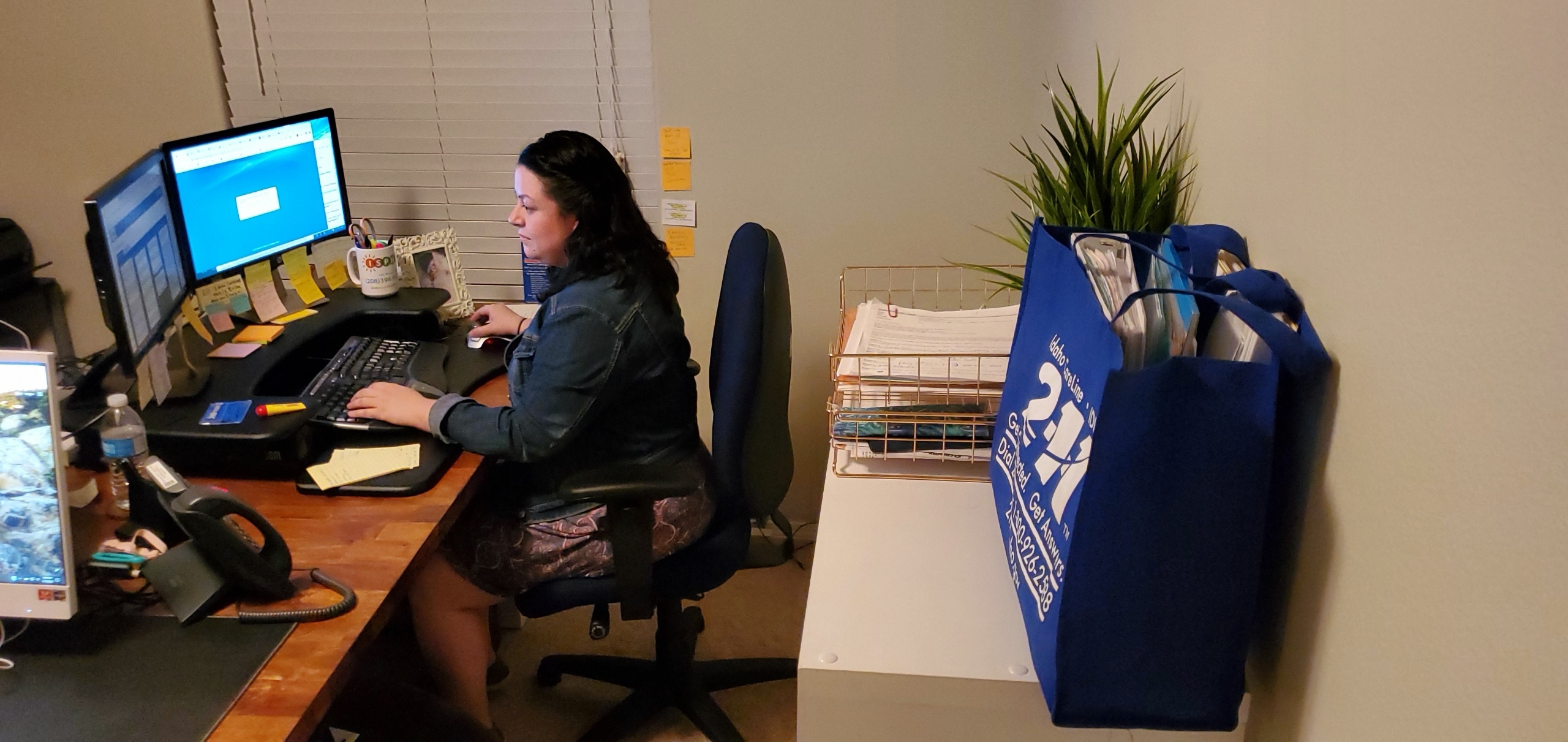
Erika Vasquez is a teleworking 2-1-1 CareLine Agent. CareLine calls are patched through to her home router through the Meraki system, so she can securely take 2-1-1 phone calls.
Erika Vasquez is a teleworking 2-1-1 CareLine Agent. CareLine calls are patched through to her home router through the Meraki system, so she can securely take 2-1-1 phone calls. Photo provided by Erika Vasquez

On a normal day at work answering calls on the 2-1-1 CareLine, Erika Vasquez sits at her work station in one corner of an open plan room. She is happily surrounded by the chatter of her six CareLine colleagues as they take back-to-back phone calls from Idahoans reaching out for information, resources, and services.

The calls are as varied as the services that Idahoans need from the department and beyond. Callers may be reaching out for help paying for rent, utilities, food, clothing, or other basic essentials. Callers might be fellow DHW employees, looking for phone numbers for department programs. Callers from the public are often looking for services offered by programs outside the department, such as social security or unemployment benefits.

When it comes to services and information available to Idahoans, Erika and her team know a bit about everything. And while it may seem they can help with most questions, they do have their limits. “We do get calls asking for the phone number for Burger King, but we won’t give them that. We might suggest they look for it on Google or in the phone book,” says Erika.

These phone conversations are punctuated by quick chats among the CareLine team members. Any time any of them need anything, they shout out to each other and help each other out. Perhaps they are stumped by a question. Perhaps they’ve just had a difficult conversation with a caller who was emotional and in crisis. Erika and her colleagues work together like clockwork, and support each other through every work day.

On any given day at work, Erika and her six colleagues each take around 60 to 100 calls per day. While the average call is one minute and forty seconds, calls can range from just one minute, to over 20 minutes. The team stagger their working hours to keep the CareLine open from 8 a.m. to 6 p.m. MST. This way, the line is open during business hours for all Idahoans, whether they are calling from the north, on Pacific Time, or from the south, on Mountain Time. Continue reading “A Day in the Life of Erika Vasquez, 2-1-1 CareLine Agent”